From Siloed Solutions to a Connected AI-First Business
On this page
- What role will AI agents play in companies, and what challenges does that bring?
- How do you keep track of these digital team members?
- How did the idea for oc8 come about?
- How do you keep costs, access rights and company knowledge under control?
- Who benefits from a central AI platform?
- Why do you rely on open source?
- What does this mean for digital sovereignty?
- What role do partners and the community play?
- What skills will companies and employees need in the future?
- What decisions should forward-looking leaders make today?
- AI doesn't transform a company because every application gets its own assistant. It transforms it when agents work together across all systems and people set the rules.
- In oc8, agents work in departments with clear roles, permissions and budgets. A person approves critical steps, and every action is logged.
- Sovereignty means the company decides where its data lives, which AI model it uses and who has access to what.
- oc8 is open source and grows with a community of partners, developers and users, backed by the BOP Alliance.
The number of AI tools is growing rapidly, and so is their importance for companies, from innovative startups to global corporations. Almost all major software vendors are building AI assistants into their products. That increases efficiency within each individual system, but it creates new data silos.
Published in "Future of AI," a publication by Smart Media distributed with Handelsblatt, October 2026.
View the original article (PDF)
With the open-source oc8 platform, companies can bring their AI agents together and orchestrate their work across systems. oc8 CEO and AI expert Tobias Hammeke explains how to stay in control of your own data along the way and become an AI-first company.
What role will AI agents play in companies, and what challenges does that bring?
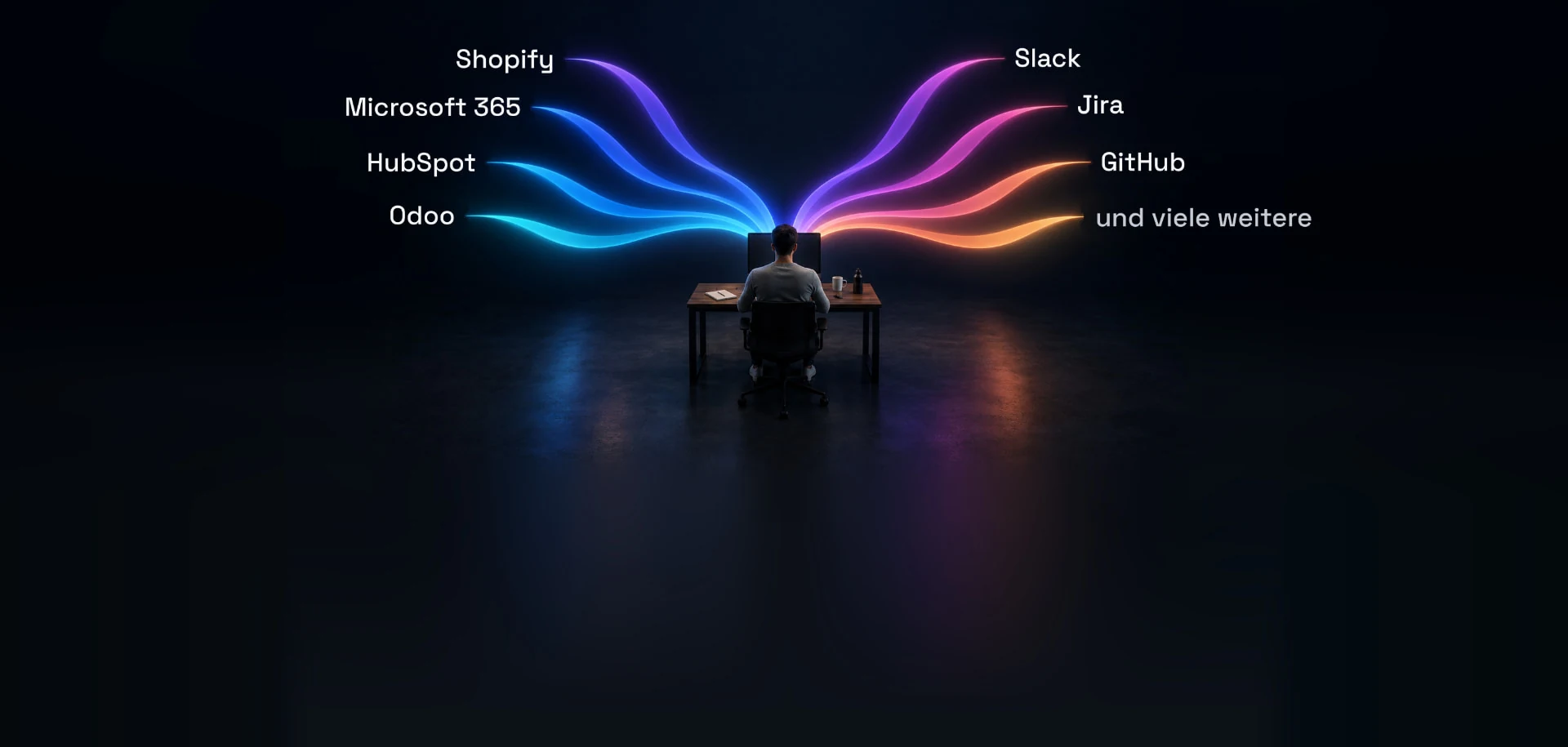
AI agents are becoming a permanent part of the team, because they don't just answer questions, they get work done. The challenge is that almost every piece of software now comes with its own AI. The CRM has one, so does the ERP, and so does the office suite. Each one works well within its own system, but none of them can see into the next, and the actual process stays manual. AI doesn't change companies by giving every application its own assistant. It changes them when agents work together across all systems and people set the rules.
How do you keep track of these digital team members?
By organizing them like real employees. In oc8, agents sit in departments with clear roles and permissions. For example, when a customer inquiry comes in through the HubSpot CRM, an agent automatically creates an opportunity and a quote in the Odoo ERP system and keeps both systems in sync. The same principle works with many other systems. A person approves critical steps in advance, and every action is logged. That way, you can see in one place which agent is working on what, instead of checking ten different systems.
How did the idea for oc8 come about?
It came out of our project work. oc8 is backed by the BOP Alliance, the alliance of leading Odoo partners worldwide, with more than 70 members in over 50 countries. For years, we've been implementing business software and making sure that systems which would otherwise run side by side actually work together. With AI agents, we saw the same pattern, only faster. That's how oc8 came about: an open platform that builds exactly this bridge for AI agents.
How do you keep costs, access rights and company knowledge under control?
With clear rules that are enforced technically. Every time an agent accesses a system, it goes through a central instance. Credentials are stored encrypted, and agents never get to see them. An agent can only access company knowledge that has been released for its department. For costs, there are budgets per agent and per department. That keeps AI spending predictable instead of quietly spreading across many tools.
Who benefits from a central AI platform?
Any company that runs more than one system and wants to use AI professionally. A startup begins with a single agent, while a large enterprise runs oc8 across many departments with its own approval processes. The industry hardly matters. Regulated companies benefit in particular, because every use of AI is documented and traceable.
Why do you rely on open source?
Because with a technology that reaches this deeply into their operations, companies should know exactly what's happening. With open-source technology, anyone can see how the platform works and what happens to their data. Then there's the pace. The AI market is moving so fast that no single vendor can cover it alone. As an open platform, oc8 grows with everyone who contributes, whether that's a new system integration or a new capability for agents. We want customers to stay with us because they want to, not because they have to.
"We want customers to stay with us because they want to, not because they have to." – Tobias Hammeke, CEO, oc8
What does this mean for digital sovereignty?
For me, sovereignty means that a company decides for itself where its data lives, which AI model it uses and who has access to what. In oc8, you can choose the model for each agent and switch at any time, whether that's Claude, ChatGPT or your own in-house model. The platform runs as SaaS or on your own infrastructure, and with local models it can even run without any outside connection. For European companies, this is essential, not least with regard to data protection and the EU AI Act. For us, sovereignty isn't an add-on feature. It's a core principle.
What role do partners and the community play?
oc8 is evolving together with a community of partners, developers and users. We deliberately rely on a strong partner model, backed by the BOP Alliance. Partners benefit in three ways. Some build their own AI-based product or services business on the oc8 SaaS platform. Others extend their existing offering: an IT service provider that implements ERP systems today can also deliver the right AI agents to its customers and, thanks to open source, tailor oc8 freely to their needs. And those who develop their own solutions can bring them to every oc8 user through our marketplace. We want our partners to grow and to build and expand their business models on this foundation.
What skills will companies and employees need in the future?
Fewer technical skills than many people think. You set up an agent in oc8 by describing what it should do, with no programming knowledge required. Process understanding and judgment become more important, because people remain accountable. They set the rules and approve critical steps. The agents do the work, and people stay in control.
What decisions should forward-looking leaders make today?
We're seeing AI evolve from individual applications into infrastructure. Platforms that orchestrate agents across the entire company are becoming the backbone, just as ERP systems are today. How seriously investors take this is shown by Wonderful AI. Founded only in 2025, the company already has around 650 employees and, following a funding round of more than $550 million, is valued at $5 billion. To roll out at customers, Wonderful relies on its own engineering teams. We're deliberately taking a different path, with open source and local partners.
For leadership, this means deciding now which shared foundation AI should run on across the company, rather than adding one standalone tool after another. That includes defining early on which tasks AI may handle on its own and where a person has to sign off. It's just as important to bring employees along. AI-first doesn't mean rebuilding everything at once. You start with one process and build from there.

Questions, or want to see oc8 live?
Get in touch, or book an online appointment — we'll walk you through the platform and explore your use cases.